









Modern humans have been around for 350000 years ago than we thought, with new research highlighting the connections between people from the distant past and the present of southern Africa.
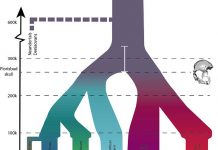
New research supports prior findings that the Khoe and San groups of southern Africa, collectively referred to as the Khoe-San or Khoisan, represent the earliest branch of the human family tree. Now DNA from their ancestors show that the first anatomically modern humans emerged 260,000-350,000 years ago.
At present, the oldest human remains we have date back 195,000 years. But these are not necessarily the first ever Homo sapiens—and the origin of our ancestry remains a mystery. How and when modern humans first emerged as a species is a major unanswered question in paleoanthropology because the fossil record is incomplete.
The findings, published in the journal Science, push back the origin of modern humans by 170,000 years, since the fossil record only goes back to 180,000 years ago. Little doubt remains that southern Africa has an important role to play in writing the history of humankind.
In a study published in Science, a team of researchers led by Marlize Lombard, from the University of Johannesburg, South Africa, looked at the remains of seven individuals who lived in KwaZulu-Natal between 2,300 and 300 years ago. Three of these lived during the Stone Age, while four others lived 300 to 500 years ago.
Lead author of the study, Carina Schlebusch, a population geneticist at Uppsala University in Sweden, explained to Seeker that the Khoe-San are the furthest related to all other populations in the world.
For example, if you draw a tree of relatedness of all human populations, the Khoe-San populations represent the first split, or divergence event, in the tree - Schlebusch said. Thereafter, rainforest hunter gatherers — ‘pygmy’ groups — split from other groups, thereafter east versus west Africans split, and thereafter all non-Africans diverge from the tree.
Because Khoe-San groups split first from the rest of human populations,” she added, “they carry the most divergent, or different, and unique DNA compared to the other human groups.
One of the fossils analyzed, known as the Ballito Bay child, was of hunter gatherer descent and would have lived at a time before any migrants had reached South Africa. As a result, his DNA was unaffected by any genetic mixing from other humans from different parts of Africa or Eurasia.
Both paleo-anthropological and genetic evidence increasingly points to multi-regional origins of anatomically modern humans in Africa, i.e. Homo sapiens did not originate in one place in Africa, but might have evolved from older forms in several places on the continent with gene flow between groups from different places. - Study author Carina Schlebusch, also from Uppsala University, said.