











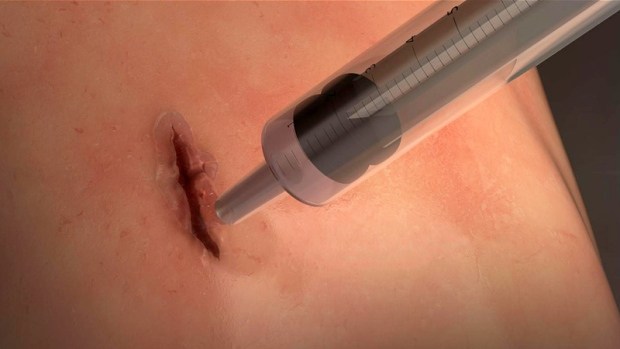
A highly elastic and adhesive surgical glue that quickly seals wounds without the need for common staples or sutures could transform how surgeries are performed. Australian and American biomedical engineers have developed a stretchy surgical glue that rapidly heals wounds, a “breakthrough” that has the potential to save lives in emergencies, its designers say.
To repair ruptured or pierced organs and tissues, surgeons commonly use staples, sutures and wires to bring and hold the wound edges together so that they can heal. However, these procedures can be difficult to perform in hard-to-reach areas of the body and wounds are often not completely sealed immediately. They also come with the risk that tissues are further damaged and infected. A particular challenge is posed by wounds in fragile or elastic tissues that continuously expand or contract and relax, like the breathing lung, the beating heart and pulsing arteries.
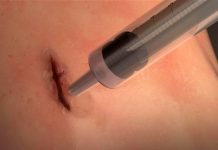
The gel is based on methacryloyl-substituted tropoelastin (MeTro for short), a hybrid elastic protein, and can be squirted onto internal and external wounds to seal them up and encourage healing.
According to the international team of researchers behind the glue, it could quite literally be a lifesaver, sealing up wounds in 60 seconds without stopping the natural expanding and relaxing of the organ or the skin it’s applied to.
A study published in journal Science Translational Medicine showed the glue quickly and successfully sealed incisions in the arteries and lungs of rodents and the lungs of pigs.
“The beauty of the MeTro formulation is that, as soon as it comes in contact with tissue surfaces, it solidifies into a gel-like phase without running away,” said lead author Assistant Professor Nasim Annabi from the Department of Chemical Engineering at Northeastern University.
MeTro combines the natural elastic protein technologies developed in collaboration with author and University of Sydney biochemist Professor Anthony Weiss, with light sensitive molecules developed in collaboration with author and director of the Biomaterials Innovation Research Center at Harvard Medical School Professor Ali Khademhosseini.
Lead author of the study, Assistant Professor Nasim Annabi from the Department of Chemical Engineering at Northeastern University, oversaw the application of MeTro in a variety of clinical settings and conditions.
“The beauty of the MeTro formulation is that, as soon as it comes in contact with tissue surfaces, it solidifies into a gel-like phase without running away. We then further stabilize it by curing it on-site with a short light-mediated crosslinking treatment. This allows the sealant to be very accurately placed and to tightly bond and interlock with structures on the tissue surface,” she said.
“The study is an excellent example of how human biology can be reengineered, tuned in different ways to create a surprisingly broad solution that can be applied back to patients in this case as surgical sealants across different tissues and scales,” said Wyss Institute Founding Director Donald Ingber, M.D., Ph.D., who also is the Judah Folkman Professor of Vascular Biology at HMS and the Vascular Biology Program at Boston Children’s Hospital, as well as Professor of Bioengineering at the Harvard John A. Paulson School of Engineering and Applied Sciences (SEAS).